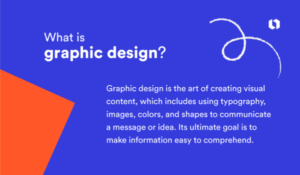
What is graphic design?
Graphic design is the art of communicating ideas through visual content. It blends creativity with strategy to create everything from digital graphics and branding to packaging, posters and social media content. Graphic designers use color, typography, layout and imagery to inform, inspire and influence audiences.
While design work may look effortless, it’s rooted in intentional choices that help businesses/organizations and individuals connect with people in meaningful ways.
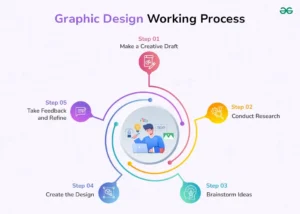
What do you do as a graphic designer?
Graphic designers wear many hats and no two jobs are exactly the same. Some designers focus on digital design for websites and apps, while others specialize in branding or print. Here are a few things you might do in a graphic design career:
- Create visual identities: Design logos, color palettes and brand systems for companies or organizations.
- Develop digital content: Design websites, mobile app interfaces and social media graphics.
- Work in marketing and advertising: Create campaigns, packaging and promotional materials.
- Support editorial design: Layout magazines, newspapers or digital publications.
- Design user experiences (UX/UI): Focus on how people interact with digital products.
You might work at a design agency, in-house at a company or as a freelance designer — which offers flexibility to build your own brand and take on client work.
What skills do graphic designers need?
Graphic design is about more than just having a good eye for design. Successful designers have a mix of creative and communication skills, including:
- Visual thinking: Understanding how to communicate ideas through images and layout.
- Typography and color theory: Using design elements to create mood and meaning.
- Design software skills: Proficiency in tools like Adobe Photoshop, Illustrator and InDesign.
- Problem solving: Finding creative solutions that meet a client’s goals.
- Feedback and collaboration: Working with others and growing from critique.
You’ll also build a portfolio which is a collection of your best design work, to show future employers or clients what you can do.
What kinds of jobs can you get in graphic design? Graphic design opens the door to many creative careers. Here are a few roles that graphic designers often pursue — along with median salary data.
- Graphic designer: $61,300 per year.
- Art director: $105,180 per year.
- UI/UX designer (categorized as web and digital interface designers): $98,090 per year.
- Brand designer: Salary varies depending on industry and title, often overlaps with graphic designer or art director roles.
- Motion graphics designer: Typically categorized under multimedia artists and animators, $98,950 per year.
- Web designer (part of web developers and digital designers): $92,250 per year.
- Creative director: Salary varies widely by industry and experience, but often starts above $100,000.
- Digital illustrator: May fall under fine artists or multimedia artists, and median around $60,000 to $80,000 per year depending on role and location.
Salary data sourced from the U.S. Bureau of Labor Statistics.
How do you know if graphic design is right for you?
If you enjoy drawing, photography or working with design software and you like solving visual problems, then graphic design could be a great match. Many designers start with an interest in art or digital media and discover how design can be used to communicate and inspire audiences.
You don’t have to be perfect at drawing or know every software tool on day one. With the right knowledge, and hands-on practice you’ll build the skills and confidence you need to grow and feel confident in your craft.
Tip: Don’t compare your journey to others. Every designer develops at their own pace, and it’s normal to feel unsure at first. Researching other artists is a great way to gather ideas and stay inspired, but remember, your style matters. Be proud of your progress and keep exploring what makes your work unique. Whether you love working with fonts or designing logos, there’s a place in the design world for your talents.
Graphic design at Central Michigan University
At Central Michigan University, you can turn your creativity into a career through our BFA in graphic design program. You’ll learn the foundations of visual communication, build strong technical skills and create a professional portfolio that reflects your style as a designer.
CMU’s graphic design program emphasizes hands-on experience, small class sizes and one-on-one faculty mentorship. You’ll explore everything from typography and branding to web design and motion graphics, and graduate ready to work in design studios, marketing agencies or tech companies.
Want to see what’s possible? Explore the graphic design program and start creating the future you want, one design at a time.
The role of the graphic designer in the communication process is that of the encoder or interpreter of the message. They work on the interpretation, ordering, and presentation of visual messages. In its nature, design pieces can be philosophical, aesthetic, emotional and political.[7] Usually, graphic design uses the aesthetics of typography and the compositional arrangement of the text, ornamentation, and imagery to convey ideas, feelings, and attitudes beyond what language alone expresses. The design work can be based on a customer’s demand, a demand that is established linguistically, either orally or in writing; that is, graphic design transforms a linguistic message into a graphic manifestation.[8]
Graphic design, as a field of application, encompasses different areas of knowledge focused on visual communication systems. For example, it can be applied in advertising strategies, or it can also be applied in the aviation world[9] or space exploration.[10][11] In this sense, in some countries graphic design is related as only associated with the production of sketches and drawings, this is incorrect, since visual communication is a small part of a huge range of types and classes where it can be applied.
With origins in Antiquity and the Middle Ages,[12] graphic design as applied art was initially linked to the boom of the rise of printing in Europe in the 15th century and the growth of consumer culture in the Industrial Revolution. From there it emerged as a distinct profession in the West, closely associated with advertising in the 19th century[13] and its evolution allowed its consolidation in the 20th century. Given the rapid and massive growth in information exchange today, the demand for experienced designers is greater than ever, particularly because of the development of new technologies and the need to pay attention to human factors beyond the competence of the engineers who develop them.[14]
Terminology
The term “graphic design” makes an early appearance in a 4 July 1908 issue (volume 9, number 27) of Organized Labor, a publication of the Labor Unions of San Francisco, in an article about technical education for printers:[15]
An Enterprising Trades Union
… The admittedly high standard of intelligence that prevails among printers is an assurance that, with the elemental principles of design at their fingertips, many of them will grow in knowledge and develop into specialists in graphic design and decorating. …
A decade later, the 1917–1918 course catalog of the California School of Arts & Crafts advertised a course titled Graphic Design and Lettering, replacing the course titled Advanced Design and Lettering. Both classes were taught by